Short answer
A single cold radiator usually has a local fault, not a boiler fault. On one-pipe steam, confirm the valve is fully open and the air vent is not clogged. On two-pipe steam, suspect the trap. On hot water, bleed out the trapped air, then check that the boiler gauge still reads about 12 to 15 psi.
When one radiator stays cold while the rest of the house heats, the problem is almost always at that radiator, not the boiler. On a one-pipe steam system the usual cause is a clogged air vent or a valve that is not fully open. On a two-pipe steam system it is often a failed steam trap. On a hot-water system it is usually trapped air, which bleeding fixes. Start by knowing which system you have, because you should never bleed a steam radiator the way you bleed a hot-water one.
Steam or Hot Water? Check This First
| Clue | One-pipe steam | Two-pipe steam | Hot water |
|---|---|---|---|
| Pipes at the radiator | One pipe with a single valve | Two pipes: a valve on the supply, a trap on the return | Two pipes, usually with a valve on one |
| Small fitting on the radiator | Air vent on the side opposite the valve, often a chrome or brass bullet shape | No vent; a trap at the bottom of the return end | Small square or slotted bleed screw near the top |
| At the boiler | Sight glass and a low-pressure steam gauge | Same as one-pipe | Combined pressure and temperature gauge, about 12 to 15 psi cold |
If the boiler has a sight glass and the radiator has a vent on its side, it is steam. Do not open that vent while the system is running. Steam at the radiator is hot enough to burn, and a vent unscrewed mid-cycle sprays it.
One-Pipe Steam: Start With the Air Vent
A one-pipe steam radiator heats only when air can escape ahead of the steam. The vent lets the air out, then closes when steam reaches it. If the vent is clogged with mineral deposits, painted over or stuck shut, air stays trapped and steam cannot get in. The radiator stays cold, or warms only near the valve.
What to check
- The valve. Make sure the supply valve is fully open. On one-pipe steam it must be all the way open or all the way closed. A half-open valve causes cold radiators, spitting and banging.
- The vent at the start of a cycle. As the boiler begins making steam, working radiators hiss as air leaves their vents. Silence from the cold radiator while the others hiss points to a blocked vent.
- The vent's position. The vent should stand upright. One tipped on its side can trap water and stop working.
- The pitch. The radiator should tilt slightly toward the valve so condensate drains. One tipped the other way can fill with water and stay cool.
With the boiler off and the radiator cold, a suspect vent unscrews by hand or with a wrench on its base. Replacing it with a new vent of the right type is the usual fix. Adjustable vents can also slow radiators near the boiler and speed up the ones at the far end, which helps balance the house.
Two-Pipe Steam: Look at the Trap
In a two-pipe steam system, air and condensate leave each radiator through a steam trap on the return side. The trap stays open for cool air and water and closes when steam arrives. Its small thermostatic element wears out over the decades, and it can fail two ways.
- Failed closed: air and water cannot leave, so the radiator stays cold or only partly warm.
- Failed open: steam blows straight into the return. That radiator may heat fine, but others lose steam, the returns run hot and pipes may bang.
Two-pipe radiators should not have vents added to them. A technician can test traps with a surface thermometer and rebuild or replace the ones that failed.
Hot Water: How to Bleed a Radiator the Right Way
A hot-water radiator that is cold at the top and warm at the bottom has air trapped in it. Bleeding lets the air out so water can fill the radiator.
- Turn the thermostat down so the circulator stops, and let the system sit for a while. With the pump off, air collects at the top of the radiators.
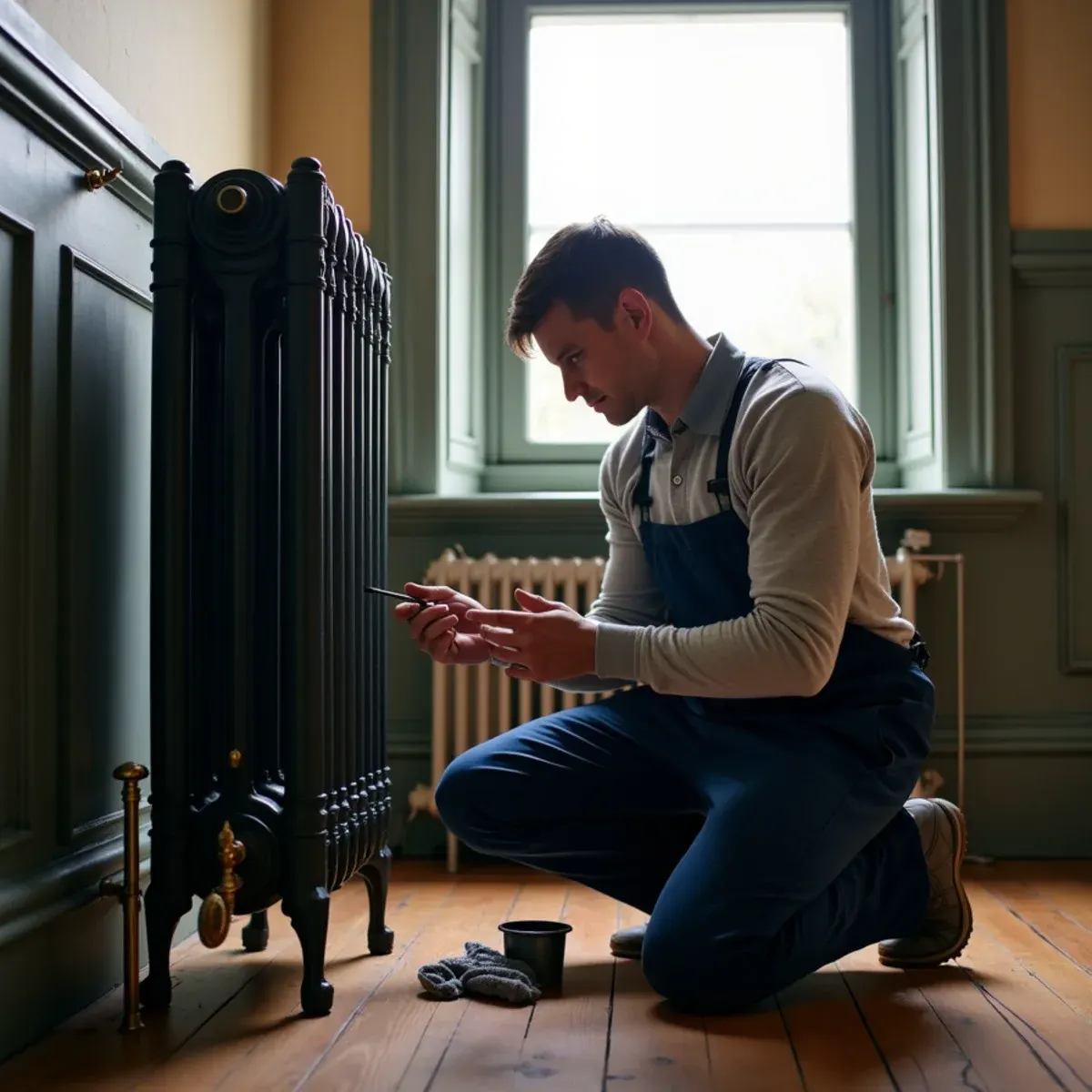
- Find the bleed screw near the top of the radiator, usually on the end opposite the supply valve. Hold a rag and a small cup under it.
- Open the screw a quarter to half turn with a radiator key or screwdriver. You will hear air hiss.
- When a steady stream of water comes out with no sputtering, close the screw snugly. Do not force it.
- Repeat on any other cold radiators, working from the lowest floor up.
- Go back to the boiler and read the pressure gauge.
Always check pressure after bleeding
Bleeding removes water as well as air. A residential hot-water boiler typically reads about 12 to 15 psi cold. If it reads lower after bleeding, the automatic fill valve should bring it back. If it does not, or the pressure keeps dropping, the system has a leak or a failed fill valve. A gauge climbing toward 30 psi, where the relief valve opens, points to an expansion tank problem. Either one needs a technician.
When the Radiator Is Still Cold
- A stuck valve. Old valves seize, or the handle turns while the disc inside stays shut. A valve that spins freely but changes nothing may be broken inside.
- Low system pressure. In a tall hot-water house, the top-floor radiators are the first to go cold when pressure drops, because there is not enough to lift water that high.
- Sludge. Decades-old systems collect sediment that can block a radiator or its connection.
- Steam distribution. If several steam radiators at the far end of the house are slow, the main vents in the basement, the pipe pitch or the pressure setting is the likely cause.
If the cold radiator also bangs, that is a separate clue. Our article on why steam radiators bang explains what the noise means.
Century-Old Radiators in Bellevue
Bellevue counts more than 1,000 buildings over a century old on 1.12 square miles above the Ohio River. In houses that age the radiators are often original while the boiler has been replaced two or three times, and each swap can leave something behind: a vent of the wrong type, a removed radiator with a capped pipe, a valve someone half-closed years ago. One cold radiator in a Lincoln Avenue Victorian is rarely a mystery, but it is often more than one small problem at once.
If you are in Bellevue or Avalon, our page on boiler and radiator service in Bellevue covers the area.
Getting the Cold Radiator Back
If a new vent, a fully open valve or a careful bleed did not fix it, call in a technician who works on radiators every day. The technician we send for radiator repair checks the vent or trap, the valve, the pitch and the system pressure, explains what is wrong and gives you a price before work starts. In a cold snap, do not let it ride: a hot-water radiator in a cold room on an outside wall can freeze and split.
From the technician's side
How a Technician Proves Which Part Is at Fault
The technician we send proves the cause before buying parts. The first two tests are safe for a homeowner with the system off and cool.
- The vent swap. Trade the suspect vent with one from a radiator that heats well. If the cold radiator now heats and the other slows, the vent was the problem. If nothing changes, suspect the valve, pitch or runout.
- The blow test. A cold one-pipe vent held upright should pass air when you blow through it and stop when turned upside down, because the float closes. One that passes nothing either way is clogged.
- The long cycle. Turning the thermostat well up for one cycle shows whether the radiator heats when the boiler runs long enough. If it does, the cycles are too short, often because the thermostat sits in a room that heats first.
- The lockshield on hot water. Many hot-water radiators carry a second, capped balancing valve on the return. Turned down during painting, it keeps the radiator cold however often it is bled. Rebalancing a floor is part of hot water boiler repair.
New vents that clog or spit within a season point downstairs, usually to wet steam or dirty boiler water, which is a steam boiler repair job rather than another vent. The long-cycle test matters most in houses like those on our steam heat in Wilkinsburg apartments page, where one boiler serves several units and the thermostat in one can end every cycle before the far unit warms.
Frequently asked questions
Should the top of a radiator be cold?
No, not on a hot-water radiator that has been running. Cold at the top and warm at the bottom means air is trapped inside, and bleeding it should fix that. On a one-pipe steam radiator, heat normally spreads from the valve end across the radiator as air vents out. If it never reaches the far end, the vent is probably too slow or blocked, or the radiator is pitched the wrong way.
How often should I bleed my radiators?
Only when they need it. A hot-water system in good shape can go a season or more without bleeding. Bleed at the start of the heating season if any radiator is cold at the top, and again if you hear gurgling. If you find yourself bleeding the same radiators every few weeks, air is getting in or the system is losing water, and a technician should find out why. Steam radiators are never bled.
Can I replace a steam radiator vent myself?
Yes, on a one-pipe steam radiator it is a common homeowner job, as long as the boiler is off and the radiator is cold. Unscrew the old vent, wrap the new vent's threads with a little thread tape and screw it in so it stands upright. Match the vent to the location: faster vents for radiators far from the boiler, slower ones nearby. Never remove or replace a vent while the system is making steam.
Why is my radiator cold at the bottom?
Usually sediment or trapped water. On a hot-water radiator, warm at the top and cool along the bottom points to sludge settled in the lower sections, blocking flow; a technician can isolate and flush that one radiator rather than the whole system. On a one-pipe steam radiator, a hot top with a cool bottom usually means condensate is pooling because the radiator tilts away from its valve. A level laid on top tells you which, and the fix for pitch is a shim under the feet at the far end.